
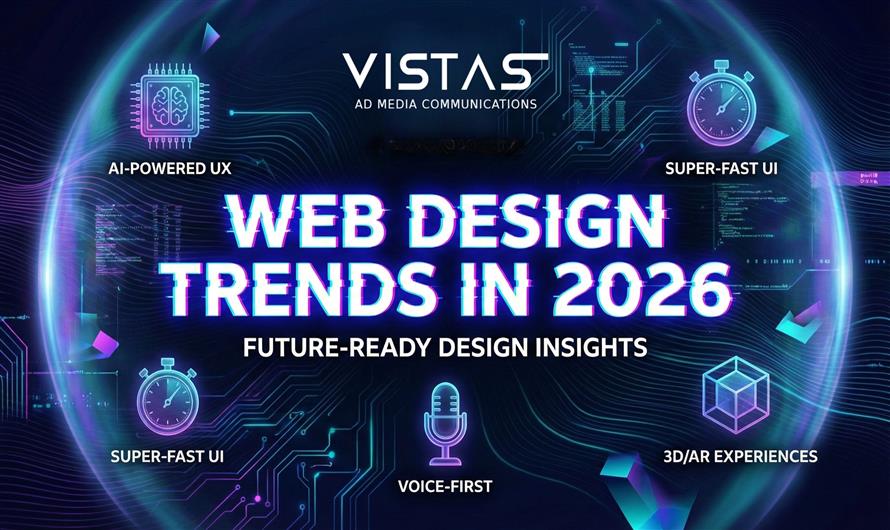
Web Design Trends in 2026: What Businesses Must Prepare For
In 2026, web design continues to evolve faster than ever, driven by AI, personalization, accessibility, and new interaction technologies. Businesses that update their websites early gain clear advantages—higher engagement, better conversions, and improved SEO visibility.
At Vistas AD Media Communications, we design future-ready websites for brands across the globe. Based on our experience and active work with leading enterprises, SMEs, and startups, here is a comprehensive look at the biggest web design trends that will define 2026.
1. AI-Powered Personalised Web Experiences Become Standard
Trend Overview
AI now plays a central role in how users experience websites. In 2026, sites will adapt in real time to:
- user behaviour
- browsing pattern
- device usage
- preferences
- location
- returning vs new visitor intent
Examples
- Product recommendations tailored to user history
- Dynamic content blocks that change per visitor
- Smart chat interfaces and AI assistants
Why It Matters
Personalisation boosts:
- Engagement
- Time on site
- Conversions
- Customer satisfaction
At Vistas, we already integrate AI-driven design systems for ecommerce, SaaS, and enterprise websites.
2. Hyper-Responsive Design to Support 100+ Device Breakpoints
With foldable phones, dual-screen monitors, 4K–8K desktops, and wearables, 2026 websites must adapt beyond the old “mobile-first” approach.
Key Requirements
- Flexible grid systems
- Advanced CSS container queries
- Fluid typography
- Optimised UX for foldable devices
- Dynamic layout reshaping
In 2026, web responsiveness isn’t just screen-size adaptation—it’s context adaptation.
3. Voice-First Navigation and Conversational UI
More than 50% of users now interact with digital products through voice. This gives rise to voice-first websites.
- - Emerging 2026 Standards
- - Voice search enabled on-site
- - Voice UI for navigation
- - Audio-driven accessibility
- Conversational forms replacing long input fields
Web development that embraces voice search sees better usability and improved SEO, especially for long-tail queries.
4. Minimalist Super-Fast User Interfaces
Users expect websites to load in under 1.5 seconds.
This pushes designers toward:
- Clutter-free, minimalist layouts
- Streamlined content structures
- Lightweight UI/UX design
- Extremely fast backends
- Minimal animations
In 2026, minimalism is not just a style—it is an SEO and performance necessity.
5. Zero-Distraction Navigation & Micro-UX Moments
Websites now prioritise simplicity. Users don’t want to “search” for what they need—they want instant clarity.
Examples
- Sticky minimal navigation bars
- Persistent utility menus
- Focused call-to-action logic
- Micro-interactions guiding user attention
These micro-UX signals improve usability and reduce bounce rate.
6. Next-Generation Scroll Experiences (But Subtle)
Scroll-based animations continue to trend in 2026, but the design language has changed.
Now Trending
- Scroll-triggered storytelling
- Data visualizations on scroll
- Subtle parallax
- Frictionless vertical journeys
Outdated
- ❌ Heavy parallax
- ❌ Oversized animations
- ❌ Long-loading effects
Visitors want smoothness—not distraction.
7. Sustainable, Eco-Friendly Web Design
Sustainability continues to influence digital decisions in 2026.
Businesses now request:
- Lower-energy webpages
- Carbon-conscious hosting
- Compressed media
- Clean code bases
- Green design certification
A “light” website performs better and uses fewer server resources.
8. Design Systems Over Traditional Design
In 2026, websites adopt component-driven design, making future updates effortless.
Benefits
- Consistent branding
- Scalable UI
- Rapid deployment
- Easier multi-language rollout
- Simpler redesign cycles
At Vistas AD Media, we create enterprise design systems that support long-termdigital transformation.
9. Security-Focused Design and Trust Signals
With cyber threats rising, websites incorporate visible trust signals into their design language:
- Visual security badges
- Transparent privacy controls
- Humanized trust cues
- Clear data-handling messages
Design is no longer aesthetic alone—it’s part of cybersecurity communication.
10. 3D, AR, and Mixed Reality (MR) Product Experiences
Ecommerce and real estate websites increasingly integrate:
- 3D product viewers
- Augmented reality previews
- MR room layout visualizers
- Digital try-on tools
Thanks to lighter WebGL and WebGPU adoption, 3D is now fast and mobile-friendly.
11. Humanized Branding with Emotionally Intelligent Design
Brands are shifting toward warm, emotive interfaces.
In 2026, websites heavily use:
- Hand-drawn elements
- Conversational copy
- Expressive typography
- Authentic visuals
- Inclusive representation
The goal is to create human-first websites that connect emotionally.
12. Privacy-First Analytics and Zero-Party Data Collection
With cookies being phased out globally, 2026 websites rely on:
- Cookieless analytics
- Privacy-first tracking
- User-consented data capture
- Transparent data exchanges
Web design and privacy now go hand in hand.
13. AI-Generated Media for Faster Web Production
Designers now leverage AI for:
- Auto-generated icons & shapes
- Color palette suggestions
- Layout ideas
- Instant wireframes
- Responsive art assets
AI speeds up production — designers focus on creativity and strategy.
14. Ultra-Readable Typography and Accessibility-Centered Layouts
Accessibility dominates 2026 design practice.
Standards Include:
- Larger font sizes
- Improved contrast
- Semantic structures
- Keyboard navigation
- Dyslexia-friendly typefaces
- Screen reader optimizations
Google also prioritizes accessibility signals in ranking.
15. Conversion-Focused Layouts Led by Data & Heatmaps
In 2026, designs are data-first, not guesswork.
We use:
- Heatmap analytics
- Scroll mapping
- Click behavior insights
- Session replays
This shapes layouts that convert better and simplify user journeys.
2026 Will Be the Year of Intelligent, Fast & Human-Centric Web Design
The future of web design lies in speed, personalisation, accessibility, AI integration, and trust-based experiences.
Brands that modernize early will win bigger market share and better customer loyalty.
At Vistas AD Media Communications, we help businesses:
- Modernize outdated websites
- Adopt AI-powered interfaces
- Implement future-proof UX
- Improve on-site conversions
- Upgrade speed, security, and SEO
If you want your website to be ready for the future, we can help you transform it into a high-performance digital asset for 2026 and beyond.


Leave Comment